
Modern buildings must meet higher expectations than ever before. Beyond aesthetics, today’s structures must prioritize fire safety, occupant protection, and acoustic comfort. Whether it’s a residential apartment, office building, healthcare facility, or mixed-use development, controlling fire spread and reducing noise transmission are critical design considerations.
This is where gypsum board plays a crucial role. Widely used for walls and ceilings, gypsum board is not just a finishing material—it is an engineered solution that significantly improves fire resistance and sound control in modern buildings.
In this guide, we’ll explore how gypsum board improves fire safety and sound control, explain the science behind its performance, examine different gypsum board types, and show why professional installation is essential for achieving maximum benefits.
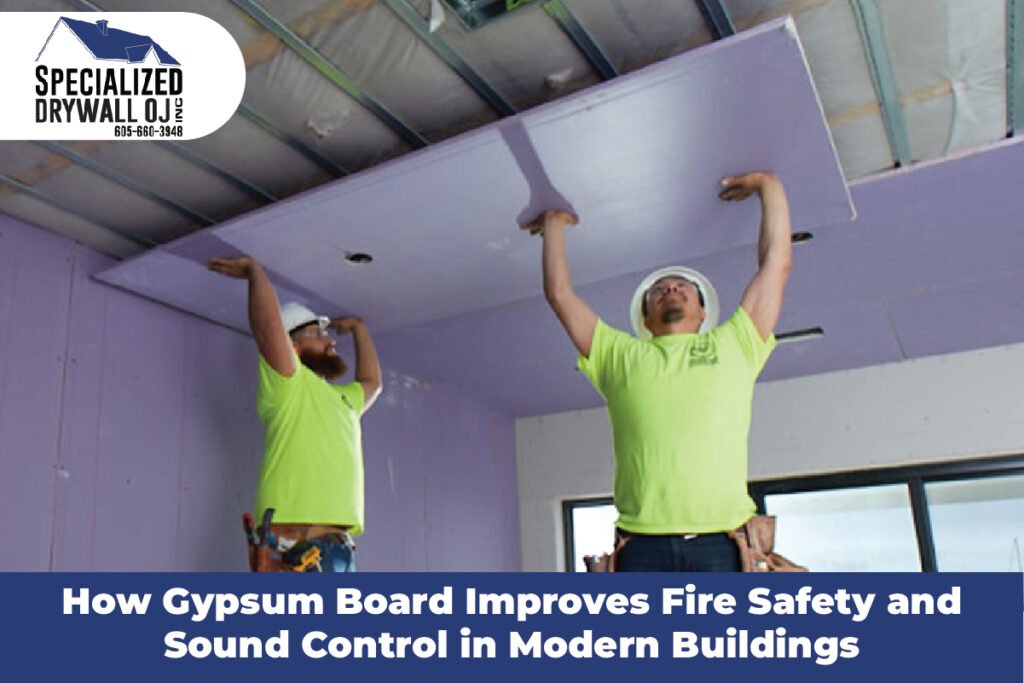
What Is Gypsum Board?
Gypsum board—also known as drywall, plasterboard, or sheetrock—is a panel made of a gypsum core sandwiched between durable paper facings. Gypsum is a naturally occurring mineral composed mainly of calcium sulfate dihydrate.
Why Gypsum Board Is Widely Used
- Non-combustible core
- Smooth, paint-ready surface
- Cost-effective and versatile
- Easy to install and repair
- Compatible with modern construction systems
While gypsum board is commonly chosen for its practicality, its fire-resistant and sound-controlling properties make it a critical safety material in modern buildings.
How Gypsum Board Improves Fire Safety
Fire protection is one of the most important reasons gypsum board is specified in residential and commercial construction.
The Science Behind Fire Resistance
Gypsum contains chemically bound water—approximately 21% of its weight. When exposed to high temperatures or fire:
- The water is released as steam
- This process absorbs heat
- The surface temperature rises more slowly
This natural reaction helps delay the spread of fire, giving occupants valuable time to evacuate and emergency services more time to respond.
Unlike many building materials, gypsum does not burn. Instead, it acts as a protective barrier, slowing heat transfer between spaces.
Fire-Rated Gypsum Board Systems
Not all gypsum boards perform the same under fire conditions. Specialized products are designed to enhance fire resistance.
Common Fire-Rated Options
- Type X Gypsum Board – Contains glass fibers to improve fire performance
- Type C Gypsum Board – Enhanced core formulation for longer fire resistance
- Multi-Layer Assemblies – Multiple layers increase fire rating duration
These systems are tested and rated to withstand fire exposure for specific time periods (e.g., 1-hour or 2-hour fire ratings), helping buildings comply with fire codes and safety standards.
Life Safety and Building Code Compliance
Gypsum board is a key component in:
- Fire-rated walls and ceilings
- Stairwells and exit corridors
- Floor-ceiling assemblies
- Fire separation between units
By slowing fire spread and limiting heat transfer, gypsum board helps:
- Protect structural elements
- Reduce fire damage
- Improve overall building safety
This makes it indispensable in modern building design and renovation projects.
How Gypsum Board Improves Sound Control
Fire safety is only part of the equation. Comfort and privacy are equally important—especially in shared or high-occupancy buildings.
Understanding Sound Transmission
Sound travels through:
- Airborne noise (voices, music, TVs)
- Impact noise (footsteps, doors)
- Structural vibrations
Gypsum board’s density and mass help reduce sound transmission by absorbing and blocking noise between spaces.
Sound Transmission Class (STC)
Sound control performance is often measured using STC ratings. Higher STC values mean better sound insulation.
Gypsum board assemblies can significantly increase STC ratings when combined with:
- Insulation
- Resilient channels
- Double-layer drywall systems
Acoustic Gypsum Board Systems
Modern construction often uses specialized gypsum solutions for enhanced sound control.
Acoustic Performance Enhancers
- Sound-rated gypsum board
- Double-stud or staggered-stud walls
- Sound-absorbing insulation
- Sealed joints and penetrations
These systems are ideal for:
- Apartments and condominiums
- Offices and conference rooms
- Hotels and hospitality spaces
- Healthcare and educational buildings
Properly designed gypsum assemblies reduce noise complaints, improve privacy, and enhance occupant comfort.
Types of Gypsum Board for Fire Safety and Sound Control
Choosing the right gypsum board is essential for performance.
Standard Gypsum Board
- Basic fire resistance
- Suitable for general residential use
Fire-Rated Gypsum Board
- Type X and Type C boards
- Used in fire-rated assemblies
- Required by building codes in many areas
Acoustic Gypsum Board
- Designed to improve sound reduction
- Often used in multi-unit or commercial spaces
Multi-Layer Assemblies
- Combines fire and acoustic performance
- Used in high-performance wall systems
Professional guidance ensures the correct product is selected for each application.
Real-World Applications in Modern Buildings
Gypsum board plays a vital role across various building types:
Residential Buildings
- Fire separation between units
- Noise reduction between rooms
- Enhanced safety in kitchens and garages
Commercial Buildings
- Office privacy and sound control
- Fire-rated corridors and stairwells
- Conference rooms and meeting spaces
Healthcare & Education
- Patient and classroom privacy
- Strict fire safety requirements
- Controlled acoustics for comfort
Mixed-Use & Adaptive Reuse
- Upgrading older buildings to meet modern codes
- Balancing safety with occupant comfort
Installation Best Practices for Maximum Performance
Even the best materials won’t perform correctly without proper installation.
Key Installation Factors
- Correct fastening and spacing
- Proper joint taping and sealing
- Continuous fire-rated assemblies
- Sealing gaps to prevent sound leaks
Professional gypsum board installation ensures:
- Fire ratings are maintained
- Acoustic performance is optimized
- Long-term durability and safety
Benefits Beyond Fire Safety and Sound Control
Gypsum board also offers:
- Smooth, attractive finishes
- Compatibility with sustainable building practices
- Low VOC options for healthier indoor environments
- Easy repair and modification
These advantages make gypsum board a long-term investment in both safety and performance.
Conclusion
Gypsum board is far more than a wall covering—it is a critical safety and performance material in modern construction. By improving fire safety and sound control, gypsum board helps protect occupants, meet building codes, and create more comfortable indoor environments.
When properly selected and professionally installed, gypsum board systems provide long-lasting protection, peace of mind, and superior building performance.
If you’re planning new construction or upgrades, investing in high-quality gypsum board solutions is one of the smartest decisions you can make.
FAQs
Ans: Gypsum contains chemically bound water that releases steam when heated, slowing fire spread and reducing heat transfer.
Ans: Yes. Its density and mass help reduce sound transmission, especially when used in layered or insulated wall systems.
Ans: No. Standard gypsum provides basic resistance, while Type X and Type C boards are specifically designed for fire-rated assemblies.
Ans: Depending on the system, gypsum board assemblies can provide fire ratings of 1 hour, 2 hours, or higher.
Ans: Absolutely. Gypsum board is widely used in homes, offices, healthcare facilities, and mixed-use developments.