
Many people assume Sheetrock services are the same for both homes and commercial buildings. But once the work starts, the differences become very clear—timelines, materials, costs, and even installation methods can vary a lot.
If you’re a homeowner, builder, or business owner planning a project, understanding these differences can help you avoid delays, extra costs, or wrong material choices.
This guide explains everything in a simple, practical way so you can choose the right Sheetrock service for your needs.
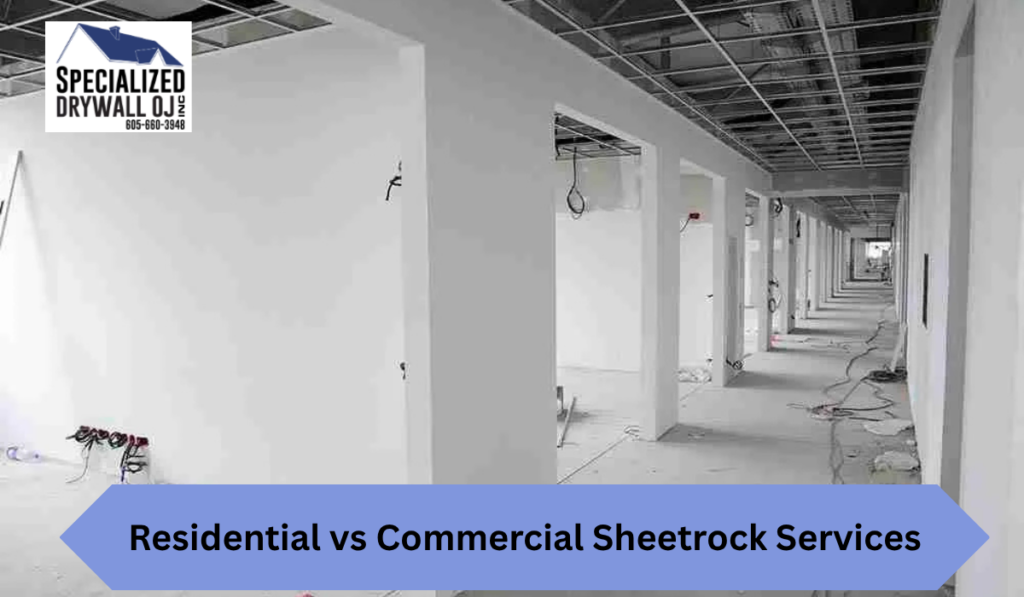
What Are Sheetrock Services?
Sheetrock services include:
- Installation of drywall panels
- Finishing and joint work
- Repairs and patching
- Ceiling and partition construction
These services are used in both homes and commercial buildings, but the way they are handled varies by project type.
Residential vs Commercial Sheetrock Services (Quick Answer)
The main difference is:
- Residential Sheetrock → Smaller, design-focused projects
- Commercial Sheetrock → Larger, more durable, and code-focused projects
Residential work focuses more on appearance and customization, while commercial work focuses on strength, safety, and efficiency.
Key Differences Between Residential and Commercial Sheetrock
1. Project Size and Scope
Residential projects usually include:
- Houses
- Apartments
- Small renovations
Commercial projects involve:
- Offices
- Shopping areas
- Warehouses
- Multi-story buildings
Commercial work is much larger and often requires bigger teams and coordination with other contractors.
2. Materials Used
Residential Sheetrock:
- Standard gypsum boards
- Moisture-resistant boards for kitchens/bathrooms
Commercial Sheetrock:
- Fire-rated boards (Type X)
- Impact-resistant boards
- Acoustic boards
Commercial materials are stronger and designed for high-traffic areas.
3. Thickness and Strength
- Residential boards → usually thinner (around 1/2 inch)
- Commercial boards → thicker and denser (often 5/8 inch or more)
This difference affects durability and safety requirements.
4. Building Codes and Requirements
Residential projects:
- Follow local building rules
- More flexibility in design
Commercial projects:
- Must meet strict safety codes
- Fire resistance and accessibility are required
This makes commercial Sheetrock work more regulated.
5. Installation Process
Residential:
- Simpler installation
- Focus on a smooth finish and design
Commercial:
- Complex systems like metal framing and suspended ceilings
- Work must be fast and precise to meet deadlines
6. Customization vs Function
Residential:
- Custom textures and designs
- Focus on the interior look
Commercial:
- Focus on function and durability
- Less emphasis on decorative details
7. Timeline and Coordination
Residential:
- Flexible timelines
- Fewer workers involved
Commercial:
- Strict deadlines
- Multiple teams working together
Project management is more demanding in commercial work.
Residential vs Commercial Sheetrock (Comparison Table)
| Feature | Residential Sheetrock | Commercial Sheetrock |
| Project Size | Small to medium | Large-scale |
| Material Type | Standard boards | Specialized boards |
| Thickness | Thinner | Thicker and denser |
| Focus | Appearance | Durability & safety |
| Installation | Simple | Complex |
| Timeline | Flexible | Strict deadlines |
| Cost | Lower | Higher |
What Many People Don’t Realize
Some important points often missed:
- Residential and commercial work require different skill sets
- Commercial projects need planning from the start due to strict codes
- Using residential materials in commercial spaces can lead to failure
- Over-specifying materials in homes increases the cost unnecessarily
Common Mistakes Buyers Make
Avoid these mistakes:
- Choosing services based only on price
- Not checking if the contractor handles commercial-scale work
- Using standard boards in high-traffic or wet areas
- Ignoring building code requirements
These issues can lead to delays, rework, or safety problems.
When to Choose Residential Sheetrock Services
Go for residential services if:
- You are working on a house or apartment
- Design and finishing matter more
- The project size is limited
When to Choose Commercial Sheetrock Services
Choose commercial services if:
- The project is large-scale
- Safety regulations are strict
- The area has high foot traffic
- You need fire-rated or durable materials
Cost Difference Explained
Residential Sheetrock:
- Lower material cost
- Less labor
- Smaller teams
Commercial Sheetrock:
- Higher material cost (special boards)
- More labor and equipment
- Longer planning and coordination
The cost difference is not just material—it’s the entire process.
Choosing the Right Service Provider
The contractor you choose matters as much as the material.
For example, companies like Specialized Drywall handle both residential and commercial Sheetrock work, ensuring:
- Correct material selection
- Proper installation methods
- Work according to the project type
This reduces the chances of errors and long-term issues.
Final Thoughts
Residential and commercial Sheetrock services may look similar at first, but they serve very different purposes. One focuses on comfort and design, while the other focuses on durability and compliance.
Choosing the right type depends on your project—not just your budget.
Call to Action
If you’re planning a Sheetrock project and want the right approach based on your space, reach out to Specialized Drywall to discuss your requirements and get the right service for your project.
FAQs
Q1: What is the main difference between residential and commercial Sheetrock services?
Residential work is smaller and design-focused, while commercial work is larger and focuses on durability and building codes.
Q2: Is commercial Sheetrock stronger than residential?
Yes, commercial Sheetrock is usually thicker and more durable for high-traffic areas.
Q3: Can residential Sheetrock be used in commercial buildings?
In most cases, no. Commercial buildings require specific materials to meet safety standards.
Q4: Why is commercial Sheetrock more expensive?
It involves stronger materials, larger teams, and stricter requirements.
Q5: Which one takes more time to install?
Commercial projects usually take longer due to their size and complexity.
Q6: Do both require professional installation?
Yes, but commercial projects, in particular, require experienced teams due to regulations and scale.
Q7: How do I choose the right service?
Choose based on your project type—home projects need residential services, while large or business spaces require commercial services.